
The Video
Transcript
Ever wonder how a light can be controlled from more than one location? It’s not magic. It’s just clever circuitry. In the next few minutes, I’ll walk you through how a three-way switch works and exactly how the current flows. Let’s get into it.
Hey, my name is Dustyn. I’m a licensed Master Electrician. Welcome to this episode of Smarter Sparky.
Imagine we have a stairwell. The code actually requires us to have a light switch at the top of the stairwell and at the bottom of the stairwell. And both of those switches have to control the lights for this stairwell. A single-pole switch can’t do that. That’s where a three-way switch comes into play. If we actually look at the back of a single-pole switch, we’ll see that there are only two connections on it. A three-way switch actually has three connections on the back. This black connection is our common, and these two gold-colored connections are our travelers.
Notice that a three-way switch does not have the words “on” and “off” written on the actual switch itself. If we take a look at a single-pole switch, a single-pole switch actually has the word “off” and “on” on the actual switch. A three-way switch does not have that. That’s actually a really easy way to check out in the field if a particular switch is a three-way switch or not.
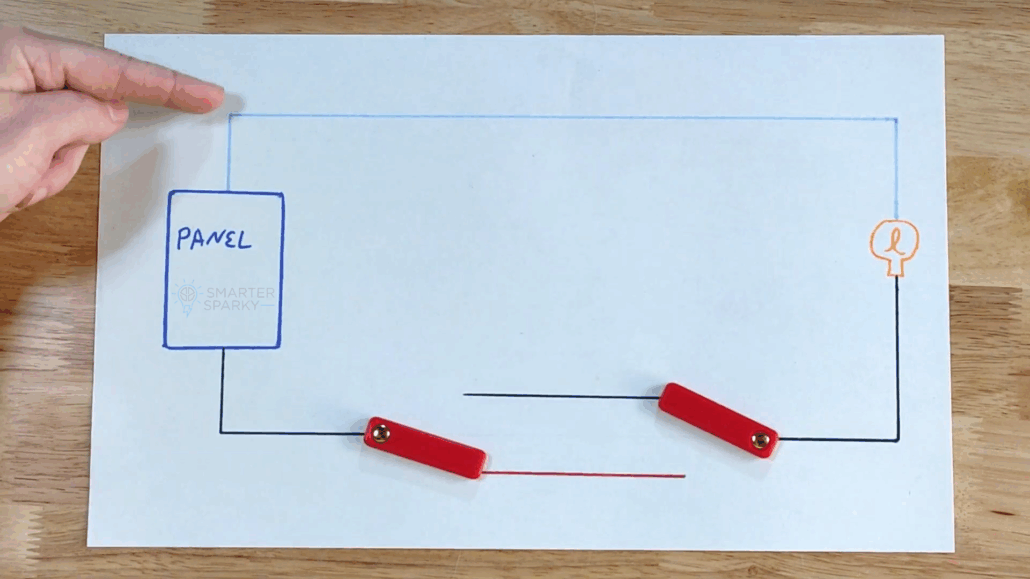
Let’s take this diagram for example. This is a very simple depiction of a three-way switch installation. Any time we use a three-way switch, we have to use two of them. So here we’ve got one three-way switch and here we’ve got another three-way switch. We can think of these as two three-way switches installed right here in the circuit. Any electrical circuit has to be a complete loop. So, from our electrical panel, this is our source of power. We’ve got our hot wire; this is our black wire leaving the panel. We’ve also got our neutral wire right here. We’re going to use the light-colored blue here for our neutral instead of white, as we cannot draw white on this white paper. Over here we’ve got our load- this is going to be a simple light bulb. This could be anything from a light bulb to a bank of light bulbs, even a receptacle we could control with a three-way switch. And then our three-way switches themselves right here. And we are able to flip these three-way switches into different locations. That is exactly what a three-way switch does when we flip the actual toggle right here. So, if we flip this one way or we flip it the other way, we are actually moving an internal paddle within that switch to a different location. So, if we actually compare this to our terminals before, remember we’ve got this black terminal and we’ve got these two gold-colored terminals. The black terminal would be this point right here and the gold-colored terminals would be these two points right here. Same on this second three-way switch. We’re going to have another three-way switch there. This black connection is going to be this common point right here. And the two gold connections are going to be these two connections right here; again, called our travelers.
So, let’s take a look at the first scenario here. I am going to preset our switches into this configuration. Now we can actually see from our panel if we follow the wires, there is actually a complete loop now. The way these switches are configured, we would actually have a complete circuit and our light bulb would be turned on. Now if we flip this second switch into the down position, now we can see that our loop is broken. So, from our panel, we’ve got our hot wire coming out here, energizing this traveler. But look, there is a disconnection at this second switch. This second switch is no longer connected. It connects to this second traveler, this red traveler down here, but there’s no connection over here either. So, in this case, this circuit would be off and there would be no current flow. Our third scenario would be if we flip this first switch into the down position. Now we can see we’ve got a complete circuit again. Current can leave the panel, go through this first switch onto this second traveler, and it can actually connect on that second switch back to the common on that second switch and be sent out to the load. In this case, completing the circuit and turning our light bulb on. We could again turn this circuit off by flipping this second or even the first switch, and now we can see we no longer have a complete circuit, right? Current no longer has a path to come out of the panel through this switch, and it’s going to go down this traveler, but there’s no connection on this second switch. Again, this is all about completing or breaking the circuit. That’s all three-way switches do.
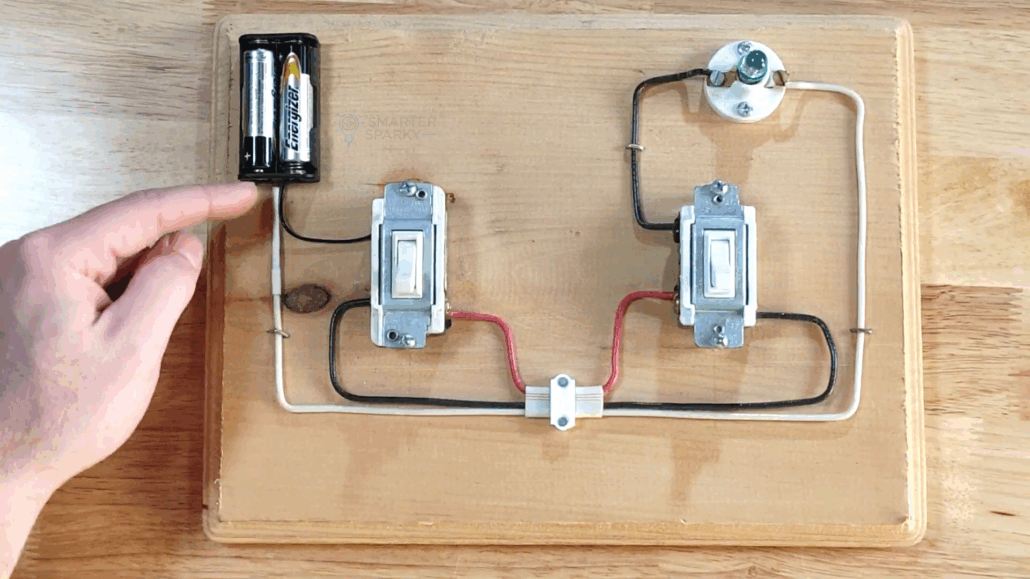
Here’s the exact circuit we just drew. Just scale down, and in this case, it runs off of AA batteries. So, we can think of these AA batteries as our electrical panel, and otherwise, the circuit works exactly the same way. We’ve got our neutral connected from the panel all the way to our load, and we’ve got our hot wire coming out of our panel, and it runs to our first switch. Now on this first switch, it is connected to that black terminal screw, and the gold terminal screws are our travelers, and we can see that the travelers from one switch connect to the travelers of the other switch. The black terminal on the second switch is connected directly to the light bulb. In this case, as the circuit sits, the light bulb is off. That means voltage is coming into this switch, but this switch is sending it to the traveler that this switch is not connected to. So just like in this scenario right here, voltage is coming in, but it might be being sent out on this red wire, but this second switch is connected to the black wire. So, if we wanted to turn this circuit on, we would have to connect that second switch to the red wire, and we could do so just by flipping that switch. Now we can see our light is on. That means that this switch is outputting voltage to the same traveler that this switch is connected to, thereby creating a complete circuit and lighting our light bulb. We could now turn this light bulb off by either flipping this switch to the other position, or we could turn the light bulb off by flipping this switch to the other position. All we’re doing is switching which travelers these switches are connecting to.
Neither switch turns the light on or off by itself. They just route the common to one traveler or the other. A common wiring mistake with three-way switches involves misidentifying this common terminal. If you mistakenly flip-flop the common in one of your travelers, your three-way switch is going to act really weird. It might work in one position, but not work in another. If that’s the case, double-check your wiring on the terminals for your switch and make sure you’ve identified that common connection. That common connection should either be where you apply power or where you pull your load from. The travelers are what get connected to the gold screws on the switch.
So, real fast recap. For a three-way switch system to work, you have to have two switches. Both of the switches are going to be connected together with travelers. The travelers get connected to these gold screws or the brass-colored screws. The common on one switch is going to go to your power source, and the common on your other switch is going to go to the load. Again, that common is the black terminal on your switch. Remember, three-way switches don’t actually turn the load on and off all by themselves. They actually need to work in a pair. All three-way switches do is route where the common is connected to, which traveler those commons are connected to. Either switch can complete or break the circuit. In this case, the circuit is broken, and in this case, the circuit is completed on traveler one or this black traveler. If we flip the switch this way, again, the circuit is broken, but if we flip this switch down, now we’ve got a completed circuit on this second traveler. Sometimes the best way to learn something is to explain it yourself. Go ahead and drop your explanation down in the comments section on how a three-way switch works. If you liked this video, check this one out on how basic Ohm’s law works for electricians. Thanks for watching this one, guys. We’ll see you on the next one. Bye.